Moulding Inserts Supplier in Berlin
Introduction
Established in 2002, NMD EXIM has grown into a trusted manufacturer, supplier, and exporter of premium brass components worldwide. Over the years, we have continuously expanded our product range, combining innovation with precision engineering to meet the evolving needs of our clients.
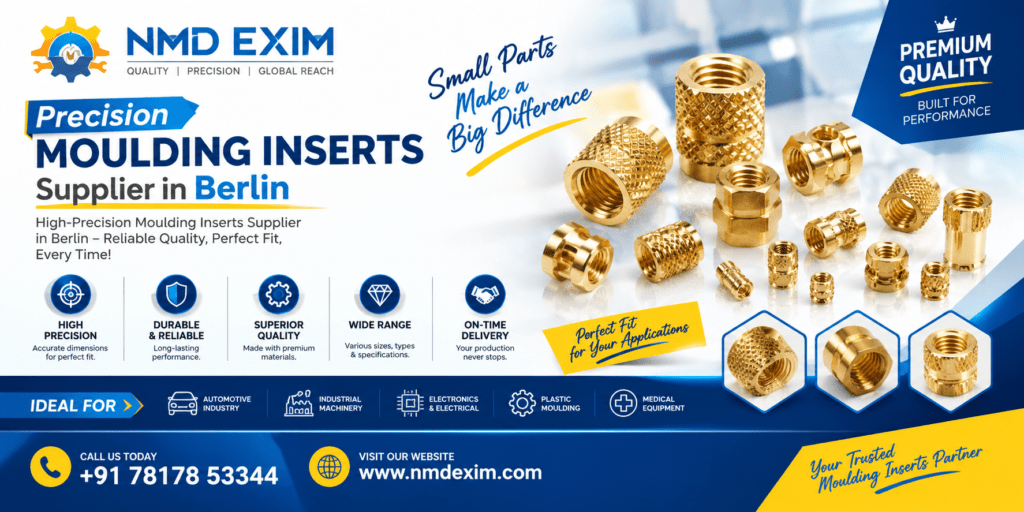
Moulding inserts are important components used in moulding and manufacturing processes to create accurate shapes, threads, holes, logos, and other required features in finished products. Industries choose moulding inserts when they need better dimensional accuracy, repeatable production, and efficient moulding operations. For businesses looking for a reliable Moulding Inserts Supplier in Berlin, NMD EXIM provides quality-focused industrial solutions for different manufacturing requirements.
NMD EXIM understands the importance of precision, durability, and consistent quality in moulding components. The company supplies moulding inserts for applications where dependable performance and accurate results are required. With a focus on customer requirements, NMD EXIM supports manufacturers, mould makers, engineering companies, and industrial buyers looking for suitable moulding insert solutions. We are the best Moulding Inserts Manufacturer.
What Are Moulding Inserts
Moulding inserts are specially designed components placed inside a mould before or during the moulding process. They become an integrated part of the final product or help create a specific feature in it. Depending on the application, moulding inserts can be used to produce threads, mounting points, holes, grooves, identification marks, and other detailed features.
These inserts are commonly used with plastic, rubber, composite, and other moulded materials. The right insert can help manufacturers achieve consistent results while reducing the need for additional machining after moulding. We are the best Moulding Inserts Exporter.
Importance of Moulding Inserts in Manufacturing
Modern manufacturing requires accuracy and repeatability. Moulding inserts can help manufacturers produce complex product features directly during the moulding process. This can simplify production and improve overall efficiency.
- Accurate moulded features
- Consistent dimensions
- Reduced secondary machining
- Improved product assembly
- Better production repeatability
- Suitable for customised applications
- Efficient manufacturing processes
For companies operating in competitive industrial markets, selecting the right moulding insert is an important part of maintaining product quality. The right insert design can also help manufacturers simplify their production process and achieve better consistency across large production quantities.
Types of Moulding Inserts
1. Threaded Moulding Inserts
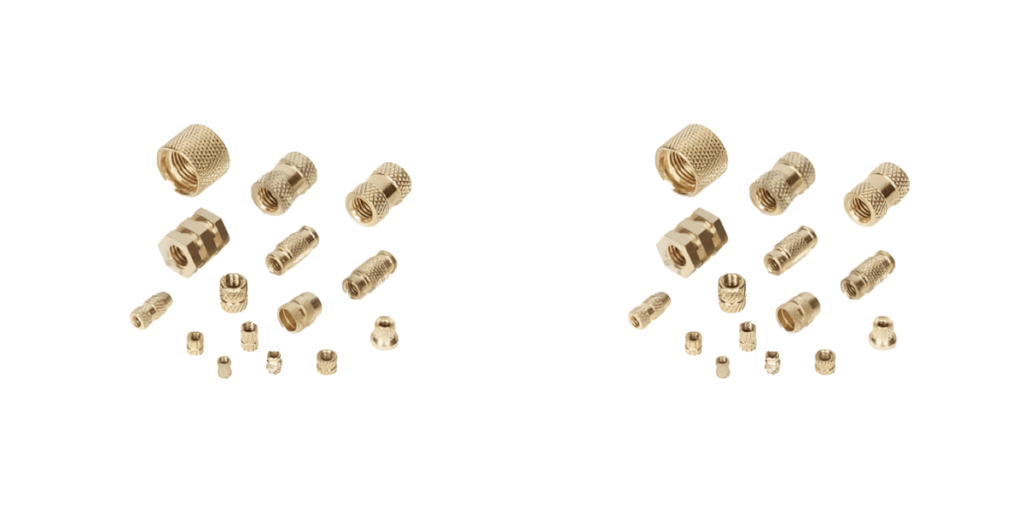
- Threaded moulding inserts are designed to provide a durable internal or external thread inside plastic or other moulded components. They are particularly useful when the base material cannot provide sufficient thread strength for repeated screw or bolt assembly. These inserts are commonly manufactured from brass, stainless steel, steel, or other suitable materials. Brass is widely used because it offers good machinability and allows accurate thread production. Threaded inserts can be supplied with different metric or other thread specifications according to the component design.
2. Knurled Moulding Inserts
- Knurled moulding inserts have a patterned or serrated external surface that helps the surrounding plastic grip the insert. The knurling improves resistance against rotation and pull-out after the material has solidified around the insert. These inserts are suitable for applications where the moulded component must withstand repeated fastening, vibration, or mechanical loading. Different knurl patterns can be selected according to the plastic material and required retention characteristics.
3. Heat-Set Inserts
- Heat-set inserts are installed into a previously moulded plastic component using controlled heat. The heat softens the thermoplastic around the installation area, allowing the insert to enter the boss. After cooling, the plastic grips the external profile of the insert. They are commonly used in electronic housings, electrical enclosures, consumer products, automotive components, and industrial plastic assemblies where strong reusable threads are required.
4. Hexagonal Moulding Inserts
- Hexagonal moulding inserts have a six-sided external profile that helps resist rotation after being embedded into the moulded material. They can be selected for applications where higher torque resistance is required. The hexagonal shape also provides a positive mechanical connection between the insert and surrounding plastic, provided that the boss and wall design are suitable.
5. Grooved and Undercut Inserts
- Grooved or undercut moulding inserts feature external grooves or recessed sections. During moulding, the plastic flows around these features and forms a mechanical lock. These inserts can be useful where strong pull-out resistance is required. The groove dimensions should be selected according to the plastic material, insert size, wall thickness, and expected loading conditions.
Applications of Moulding Inserts
1. Automotive Components
- Moulding inserts are widely used in automotive plastic and rubber components. They can provide durable mounting points and threaded connections in dashboards, interior panels, sensor housings, brackets, covers, connectors, and other moulded components. Metal inserts can also help combine the mechanical properties of metal with lightweight plastic parts.
2. Electrical and Electronic Products
- Electrical housings, switchgear components, connector bodies, control panels, terminal covers, and electronic enclosures often require secure fastening points. Moulding inserts provide strong and reusable threads inside plastic components, helping screws and fasteners maintain a reliable connection.
3. Plastic Enclosures and Housings
- Plastic boxes, covers, equipment housings, instrument cases, and protective enclosures commonly require internal threaded points for assembly. Moulding inserts can be incorporated during manufacturing so that the finished housing has a strong fastening location. This makes them useful for industrial equipment, electronic devices, communication products, and consumer products.
4. Industrial Machinery
- Industrial machinery and equipment frequently use moulded covers, protective guards, handles, brackets, panels, and technical components. Moulding inserts can strengthen the connection areas and provide durable mounting points. They are particularly useful where plastic alone may not provide the required thread strength or repeated fastening performance.
5. Plumbing and Fluid-Handling Components
- Moulding inserts are also used in plastic plumbing and fluid-handling components where a strong threaded or mechanical connection is required. Brass and other corrosion-resistant materials can be selected according to the application and operating environment. Custom inserts can be manufactured according to drawings or samples when a standard component does not meet the required dimensions.
6. Rubber and Elastomer Components
- Metal moulding inserts can be incorporated into rubber and elastomer products to create rigid mounting points, sleeves, connection interfaces, and reinforcement areas. The metal insert provides structural support while the rubber can provide flexibility, sealing, vibration absorption, or damping. These inserts are useful in rubber mounts, vibration-control components, seals, bushes, and other engineered rubber products.
7. Medical and Laboratory Equipment
- Precision moulding inserts can be used in medical and laboratory equipment where plastic components require accurate mounting or connection features. In specialised applications, insert moulding can combine thermoplastic or silicone materials with metal or plastic inserts to create functional assemblies. Where cleanliness, dimensional accuracy, and material compatibility are important, the insert and moulding process must be selected according to the product requirements.
8. Telecommunications Equipment
- Telecommunication boxes, connector housings, networking equipment, communication panels, and other technical enclosures may require strong fastening points. Moulding inserts can provide durable threads in lightweight plastic components while maintaining a compact design.
9. HVAC and Refrigeration Equipment
- HVAC and refrigeration components can require secure threaded mounting points and connection interfaces. Moulding inserts can be incorporated into plastic housings, brackets, covers, and other technical components used in these systems.
10. Furniture and Fittings
- Moulding inserts are also suitable for furniture components, plastic fittings, mounting accessories, and assembly parts. They can provide a stronger threaded connection than the surrounding plastic and are useful where components need to be assembled or removed multiple times.
12. Instrumentation and Control Equipment
- Industrial instruments, measuring equipment, control systems, and monitoring devices often use compact plastic housings. Moulding inserts can provide mounting points for screws, panels, sensors, and other components. Precision manufacturing is especially important for these applications because insert position, dimensions, thread quality, and alignment can affect final assembly.
Benefits of Moulding Inserts
1. High Dimensional Accuracy
- Precision moulding inserts help maintain accurate dimensions during plastic injection moulding. Properly manufactured inserts can create consistent cavities, cores, holes, threads, ribs, and other detailed features. For manufacturers in Berlin working with precision plastic components, accurate inserts can help reduce dimensional variations and support consistent finished-part quality.
2. Improved Product Quality
- The quality of the mould insert directly influences the surface and dimensional characteristics of the moulded component. Properly finished inserts can help produce clean surfaces, accurate details, and repeatable moulding results. This is particularly useful for products where appearance, fit, and dimensional consistency are important.
3. Easier Mould Maintenance
- One of the major benefits of replaceable mould inserts is easier maintenance. If a particular section of a mould becomes worn or damaged, the insert can potentially be replaced instead of rebuilding the complete mould. This can simplify maintenance and reduce the amount of tooling work required.
4. Reduced Production Downtime
- Replaceable inserts can help manufacturers restore a damaged mould section more efficiently. Instead of replacing a complete mould, only the affected insert may need attention. For production environments, this can support faster maintenance and help reduce interruptions to manufacturing schedules.
5. Better Wear Resistance
- Mould inserts can be manufactured from suitable tool steels and other engineering materials selected according to the application. Appropriate material selection and heat treatment can help an insert withstand repeated moulding cycles, mechanical stress, and wear. This is particularly important for moulds used for continuous or high-volume production.
6. Improved Mould Flexibility
- Using separate inserts gives mould designers greater flexibility. Specific portions of a mould can be modified, replaced, or redesigned without necessarily changing the complete tooling structure. This flexibility can be valuable when manufacturers produce different product variants using related mould designs.
7. Cost-Effective Mould Repair
- Replacing an individual insert can be more economical than manufacturing an entirely new mould or rebuilding a complete cavity or core. The actual cost benefit depends on mould construction, insert design, material, damage level, and production requirements. For manufacturers looking to control tooling maintenance expenses, replaceable inserts can therefore be an important consideration.
8. Consistent Production Performance
- Precision inserts help maintain repeatable mould geometry over multiple production cycles. Consistent positioning and accurate insert dimensions are important for maintaining the same part characteristics from batch to batch. Proper insert positioning also helps prevent movement during the injection process.
9. Improved Mechanical Strength
- When moulding inserts are used as part of an insert-moulded component, the combination of plastic and metal can provide additional structural strength. Metal inserts can support areas that require greater mechanical loading while the surrounding plastic provides design flexibility and lower weight.
10. Reduced Assembly Requirements
- Insert moulding can integrate components such as threaded bushings, contacts, pins, and other pre-formed elements directly into plastic parts. This can reduce or eliminate certain secondary assembly operations. As a result, manufacturers may benefit from fewer production steps, lower assembly requirements, and more consistent component positioning
Why Choose NMD EXIM
1. High-Quality Moulding Inserts
- A professional Moulding Inserts Supplier in Berlin focuses on supplying inserts manufactured according to required dimensions and application specifications. Quality inserts can provide reliable fastening, mounting, reinforcement, or connection points in moulded components. Depending on the application, moulding inserts may be produced from materials such as brass, steel, stainless steel, copper, or suitable engineering materials.
2. Suitable for Different Applications
- Moulding inserts are used across many industrial applications where a moulded plastic or rubber component needs additional mechanical or functional features. Threaded bushings, metal sleeves, contacts, pins, busbars, and other inserts can be integrated into moulded components. A knowledgeable Moulding Inserts Supplier in Berlin can therefore support requirements for electrical components, automotive parts, industrial housings, medical components, consumer products, machinery parts, and other engineered products.
3. Improved Component Strength
- One important reason to use moulding inserts is to provide stronger connection points within plastic components. Metal inserts can provide durable threads, mounting interfaces, and load-bearing points where plastic alone may not provide the required performance. Insert moulding can also create a combined metal-and-plastic hybrid component.
4. Reduced Assembly Requirements
- Insert moulding can integrate an insert directly into the moulded component, reducing the need for certain secondary assembly operations. This can help simplify production processes and potentially reduce handling and assembly costs. For manufacturers, this means a finished component can combine multiple functions in one integrated part rather than requiring separate components to be installed later.
5. Precision and Consistent Dimensions
- Precision is essential when moulding inserts are used inside engineered components. Accurate dimensions and positioning help ensure that the insert fits correctly within the mould and performs as intended in the finished product. A capable supplier should understand important factors such as insert geometry, tolerances, mould positioning, sealing, material compatibility, and the interaction between the insert and moulding material. Industry specialists highlight accurate insert positioning and sealing as important aspects of successful insert-moulding production.
6. Customised Solutions
- Every industrial component requires the same insert. Depending on the product design, customers may require different thread sizes, lengths, diameters, shapes, materials, or surface finishes. A reliable Moulding Inserts Supplier in Berlin can support customised requirements based on technical drawings, sample files, or application specifications. Custom solutions are particularly useful for specialised machinery, electrical assemblies, automotive components, and engineered plastic products.
Moulding Inserts for Industrial Manufacturing
Modern manufacturing requires components that provide both functionality and production efficiency. Moulding inserts are useful because they allow fastening and mounting features to be integrated directly into moulded components.
A properly selected insert can help reduce secondary operations, simplify assembly, and improve the overall usability of a finished component. This makes moulding inserts valuable for manufacturers producing high-volume as well as specialised components.
For companies searching for a dependable Moulding Inserts Supplier in Berlin, it is important to work with a supplier that understands industrial requirements and can provide suitable products according to application needs.
Conclusion
Moulding inserts play an important role in plastic, rubber, automotive, electrical, electronics, and engineering applications. They provide strong fastening points, improve component functionality, and can reduce the need for additional machining and assembly operations. We are the best Moulding Inserts Exporter in Gujarat.
Choosing the right Moulding Inserts Supplier in Berlin can support consistent production, reliable component performance, and efficient manufacturing. NMD EXIM provides industrial supply solutions with a focus on quality, accuracy, customer requirements, and dependable service.