
Thread Inserts Supplier in Brazil
Introduction
Established in 2002, NMD EXIM has grown into a trusted manufacturer, supplier, and exporter of premium brass components worldwide. Over the years, we have continuously expanded our product range, combining innovation with precision engineering to meet the evolving needs of our clients.
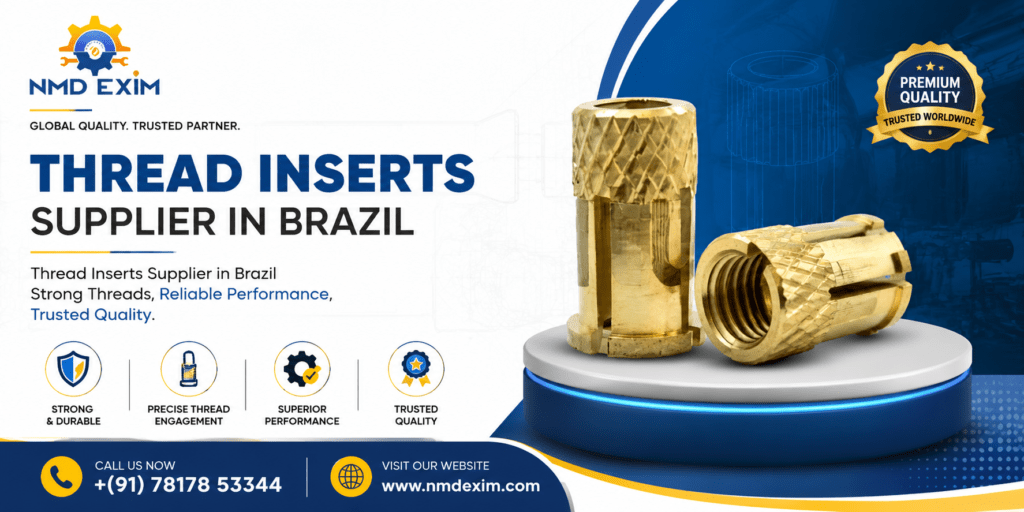
Thread inserts are important components used to create strong, reliable, and durable threads in different materials. They are widely used in automotive, engineering, electronics, aerospace, machinery, and industrial applications. For companies looking for a dependable Thread Inserts Supplier in Brazil, choosing the right supplier is essential for maintaining product quality and production efficiency.
NMD EXIM is a trusted supplier and exporter of industrial fastening and engineering components, offering quality Thread Inserts for different industrial requirements. With a focus on product quality, dimensional accuracy, and customer satisfaction, NMD EXIM serves customers looking for reliable threaded solutions.
What Are Thread Inserts
Thread inserts are specially designed components installed into a pre-drilled hole to provide a strong internal thread. They can be used in materials such as aluminium, plastic, magnesium, wood, and other softer materials where a conventional threaded hole may not provide sufficient strength.
A thread insert helps improve thread durability and allows repeated installation and removal of screws or bolts without damaging the base material. This makes them a practical solution for manufacturing and repair applications. Thread inserts provide a durable threaded surface and can also be used to repair damaged threads. Depending on the application, different types, sizes, materials, and thread standards are available.
Why Are Thread Inserts Important
In many industrial applications, the base material may not be strong enough to hold a conventional thread. Thread inserts solve this problem by creating a durable and reinforced threaded connection.
- Improved thread strength
- Better resistance to wear
- Longer service life
- Easy installation and replacement
- Suitable for repeated fastening
- Protection against thread damage
- Improved reliability of assembled components
Because of these advantages, thread inserts are commonly used in demanding industrial environments. A threaded connection may become damaged due to repeated tightening, vibration, corrosion, or excessive load. Thread inserts provide an effective solution by reinforcing the threaded area.
Why Choose NMD EXIM
1. High-Quality Thread Inserts
- Quality is one of the most important factors when selecting a Thread Inserts Supplier in Brazil. Precision-manufactured inserts provide accurate thread engagement and a secure connection. High-quality products can help prevent thread stripping, loosening, deformation, and premature wear during repeated assembly operations.
2. Wide Range of Thread Insert Types
- A professional supplier should offer different types of thread inserts to meet different installation and application requirements. Common options include heat-set inserts, ultrasonic inserts, press-fit inserts, mould-in inserts, self-tapping inserts, knurled inserts, blind inserts, and custom-designed inserts. This variety allows manufacturers to select the most suitable insert based on the base material, installation process, required holding strength, and production volume.
3. Suitable for Plastic and Polymer Components
- Thread inserts are especially useful for plastic components where directly tapped threads may not provide sufficient durability. Inserts create a reinforced threaded connection and can withstand repeated fastening cycles better than threads formed directly in many soft materials. They are commonly used in plastic housings, electrical enclosures, automotive components, electronic equipment, appliance parts, and injection-moulded products.
4. Strong and Reliable Thread Connections
- One of the major benefits of using thread inserts is their ability to provide strong and reliable fastening points. Knurled and specially profiled inserts can provide mechanical resistance against rotation and pull-out when installed correctly. This makes them suitable for applications where vibration, repeated assembly, or mechanical loading is expected.
5. Multiple Material Options
- Different industries require different material properties. Thread inserts may be available in brass, stainless steel, steel, and aluminium, allowing the product to be selected according to strength, corrosion resistance, weight, conductivity, and environmental conditions. Brass inserts, for example, are commonly used in plastic and electrical applications, while stainless steel options can be selected for applications requiring greater corrosion resistance.
6. Metric and Inch Thread Availability
- Brazilian industries may work with different equipment, imported machinery, and international component designs. Therefore, a good supplier should be capable of providing both metric and inch thread configurations. This flexibility helps manufacturers source inserts that match existing bolts, screws, studs, and assembly components.
7. Custom Thread Inserts
- Not every industrial application does not necessarily use a standard insert. Components may require a particular outside diameter, length, thread size, knurling pattern, head shape, material, or tolerance. An experienced supplier can manufacture custom thread inserts according to drawings, samples, dimensions, and technical specifications. Customisation can help ensure proper fitment and improve the performance of the finished assembly.
8. Precision and Dimensional Accuracy
- Precision is essential for thread inserts because the insert must fit correctly inside the prepared component while providing accurate internal threading. Consistent dimensions help maintain proper alignment between the insert and mating fastener. Professional manufacturers use controlled production and inspection processes to maintain dimensional consistency, thread accuracy, and repeatability across batches.
9. Better Resistance to Wear
- Thread inserts can provide a more durable fastening point than threads formed directly in softer materials. They are particularly beneficial where screws need to be removed and reinstalled several times during maintenance, servicing, or product assembly. This makes them useful for machinery, electronics, automotive components, appliances, industrial equipment, and other products requiring serviceable connections.
10. Wide Industrial Applications
- A reliable Thread Inserts Supplier in Brazil can serve multiple industries with application-specific fastening solutions. Thread inserts are used across automotive, electronics, electrical equipment, aerospace, furniture, telecommunications, machinery, medical equipment, marine products, and plastic moulding applications. Their ability to create strong reusable threads makes them valuable for both high-volume manufacturing and specialised industrial assemblies.
11. Consistent Quality for Bulk Requirements
- Manufacturers often require thousands or millions of inserts for regular production. Consistent quality from batch to batch is therefore essential. A professional supplier should have appropriate quality-control procedures covering raw material, dimensions, thread accuracy, surface finish, and final inspection. Consistency helps reduce assembly problems, production downtime, rejected components, and unnecessary replacement costs.
12. Cost-Effective Long-Term Solution
- Although the initial cost of a thread insert is an additional component expense, it can provide significant long-term value by improving thread durability and reducing failures caused by stripped or damaged threads. For products requiring repeated assembly and maintenance, durable inserts can extend the usable life of fastening points and reduce repair requirements.
14. Reliable Supply for Brazilian Industries
- For manufacturers in Brazil, dependable supply is important for maintaining uninterrupted production. A capable Thread Inserts Supplier in Brazil should be able to support standard requirements as well as customised orders and larger-volume production. Reliable availability, consistent specifications, proper packaging, and responsive customer support can make the procurement process easier for manufacturers, distributors, and engineering companies.
Applications of Thread Inserts
1. Automotive Industry
- Thread inserts are extensively used in automotive components such as engine parts, transmission housings, dashboards, brackets, body components, and other assemblies. They provide strong internal threads in materials such as aluminium, magnesium, plastics, and composites. Thread inserts also help improve resistance to vibration and repeated fastening.
2. Aerospace Industry
- The aerospace industry requires lightweight components with high mechanical strength and dimensional reliability. Thread inserts are used in aircraft structures, interior assemblies, seating systems, panels, engine components, and electronic equipment. They provide durable threaded connections while helping maintain the overall weight of the assembly.
3. Electrical and Electronics Industry
- Thread inserts are commonly used in electrical panels, switchgear, control cabinets, electronic housings, and equipment enclosures. They provide secure mounting points for screws and bolts and are particularly useful in plastic and aluminium housings where conventional threads may not provide sufficient strength.
4. Industrial Machinery
- Machinery manufacturers use thread inserts in machine housings, frames, covers, fixtures, brackets, and precision equipment. They allow components to be assembled and removed multiple times without damaging the base material. This makes them suitable for machinery that requires regular maintenance and servicing.
5. Plastic Components
- Plastic components may not always provide sufficient thread strength for high-load fastening applications. Thread inserts create a stronger and more wear-resistant threaded connection inside plastic parts. They are used in injection-moulded components, electrical housings, consumer products, automotive plastics, and industrial equipment.
6. Aluminium Components
- Aluminium is lightweight and corrosion-resistant, but its relatively soft structure can result in thread wear during repeated fastening. Thread inserts reinforce aluminium threads and improve their load-bearing capacity. They are used in aluminium housings, machine components, automotive parts, and structural assemblies.
7. Medical Equipment
- Thread inserts are used in medical devices, diagnostic equipment, laboratory instruments, equipment housings, and precision assemblies. They provide reliable fastening points and support repeated maintenance and component replacement where required.
8. Railway Industry
- Railway equipment is exposed to vibration, mechanical loads, and demanding operating conditions. Thread inserts can be used in railway interiors, electrical systems, equipment housings, panels, and mechanical assemblies to provide strong and dependable threaded connections.
9. Renewable Energy Equipment
- Solar equipment, wind-energy systems, electrical enclosures, mounting assemblies, and related machinery can use thread inserts for secure fastening. Their ability to provide durable threads in lightweight materials makes them suitable for modern energy equipment.
10. Construction and Infrastructure Equipment
- Thread inserts are used in construction machinery, control panels, access equipment, structural components, and industrial assemblies. They provide reinforced fastening points and can help extend the service life of components subjected to regular assembly and maintenance.
11. Robotics and Automation
- Robotic systems require precision, lightweight construction, and reliable fastening. Thread inserts are used in robotic arms, sensor housings, automation equipment, grippers, control units, and machine frames. They provide strong threads while supporting repeated assembly and adjustment.
12. Defence and Heavy Engineering
- Thread inserts can be used in specialised engineering equipment, enclosures, machinery, and structural assemblies where dependable threaded connections are important. Depending on the application, inserts can be selected according to material compatibility, mechanical strength, temperature requirements, and environmental conditions.
Specification Table of Thread Inserts
| Parameter | Specification |
|---|---|
| Material | Thread Inserts |
| Product | Stainless Steel, Carbon Steel, Brass, Phosphor Bronze |
| Thread Type | Metric, UNC, UNF, BSP, NPT |
| Thread Size | M2 to M20 / As per requirement |
| Insert Type | Helical, Self-Locking, Solid, Key-Locking |
| Length | 1D, 1.5D, 2D, 2.5D, 3D and Custom |
| Surface Finish | Passivated, Zinc Plated, Plain / As Required |
| Temperature Resistance | Depends on Material and Application |
| Corrosion Resistance | High |
| Installation | Manual or Pneumatic/Electric Installation |
| Application | Automotive, Aerospace, Electrical, Machinery, Engineering |
| Customization | Available as per drawing and specifications |
| Standards | DIN, ISO, ASME and Customer Specifications |
| Packaging | Bulk, Box or Customized Packaging |
Benefits of Thread Inserts
1. Improved Thread Strength
- One of the major benefits of thread inserts is their ability to strengthen internal threads. When screws are installed directly into soft materials such as aluminium, plastic, or composites, the threads may strip under high torque or repeated use. A suitable thread insert provides a stronger threaded surface and distributes the applied load more effectively.
2. Excellent Wear Resistance
- Thread inserts are particularly useful where components need to be assembled and disassembled repeatedly. The insert protects the original material from continuous thread wear, helping maintain thread accuracy and fastening performance over a longer service period.
3. Reliable Vibration Resistance
- Industrial equipment can experience continuous vibration, shock, and dynamic loads. Properly selected thread inserts can provide a secure and stable threaded connection, while locking-style inserts can further help prevent fastener loosening in demanding applications.
4. Effective Thread Repair
- A damaged, stripped, or worn threaded hole does not always require replacement of the complete component. Thread inserts can restore the usable thread and allow the existing part to return to service. This can reduce material waste, repair time, and replacement expenses.
5. Suitable for Soft and Lightweight Materials
- Thread inserts are highly beneficial when working with materials that cannot provide sufficient thread strength on their own. They are commonly used in aluminium alloys, plastics, composites, brass, magnesium alloys, and other materials where direct tapping may not provide adequate durability.
6. Better Load Distribution
- A thread insert helps transfer fastening forces into the surrounding base material over a larger and more controlled area. This improves the load-bearing capability of the connection and reduces the likelihood of thread deformation or pull-out when the correct insert and installation method are selected.
7. Longer Component Life
- Repeated tightening and loosening can gradually damage directly tapped threads. Thread inserts act as a durable interface between the fastener and the base material, allowing components to withstand more assembly cycles and extending their useful service life.
8. Cost-Effective Maintenance
- Using thread inserts can be an economical solution for both new manufacturing and repair work. Instead of replacing an expensive component because of a damaged threaded hole, manufacturers can often restore the connection with an appropriate insert. This can reduce downtime, replacement costs, and maintenance requirements.
9. Wide Range of Applications
- Thread inserts are available in different designs and installation methods, including self-tapping, press-fit, heat-set, helical, and key-locking varieties. This allows manufacturers to select an insert according to the base material, load requirements, wall thickness, production method, and service conditions.
10. High Precision and Consistent Threading
- A quality Thread Inserts Supplier in Brazil can provide inserts manufactured to appropriate dimensional and thread specifications. Consistent thread geometry helps achieve reliable screw engagement, improved assembly accuracy, and repeatable performance across production batches.
11. Corrosion and Temperature Resistance
- Depending on the material selected, thread inserts can provide resistance against moisture, corrosion, chemicals, and elevated temperatures. Stainless steel, brass, and other specialised materials can be selected for applications where environmental resistance is important.
Types of Thread Inserts
1. Helical Thread Inserts
- Helical thread inserts are made from specially formed wire and provide strong internal threads. They are commonly used in repair applications and in materials where additional thread strength is required. They are suitable for automotive components, machinery, aerospace equipment, and general engineering applications.
2. Self-Tapping Thread Inserts
- Self-tapping thread inserts are designed to create their own thread when installed into a suitable pilot hole. They are commonly used in plastics, soft metals, wood, and composite materials. Their simple installation makes them suitable for manufacturing and assembly operations where production efficiency is important.
3. Threaded Inserts for Plastics
- Plastic components often require stronger threads for screws and fasteners. Threaded inserts provide a durable metal thread inside plastic components. They are widely used in electrical equipment, automotive parts, consumer products, industrial enclosures, and injection-moulded components.
4. Press-Fit Thread Inserts
- Press-fit inserts are installed by pressing them into a prepared hole. They are useful where quick installation and a secure connection are required. These inserts are commonly used in sheet metal, plastic components, electrical assemblies, and industrial equipment.
5. Brass Thread Inserts
- Brass thread inserts offer good corrosion resistance and are frequently used with plastic components. They provide a strong threaded connection while maintaining good electrical and mechanical properties. They are commonly used in electrical products, electronic housings, appliances, and precision components.
Conclusion
Thread inserts provide a practical solution for creating strong, durable, and reusable threaded connections. They are widely used in automotive, electronics, machinery, plastics, aerospace, and general engineering applications. With different options such as helical inserts, self-tapping inserts, press-fit inserts, brass inserts, stainless steel inserts, and locking inserts, manufacturers can select the right solution for their requirements.
For businesses looking for a dependable Thread Inserts Supplier in Brazil, NMD EXIM offers quality-focused threaded insert solutions for a wide range of industrial applications. With a commitment to product quality, dimensional accuracy, flexible requirements, and customer satisfaction, NMD EXIM can be a reliable sourcing partner for thread inserts and other industrial components.